
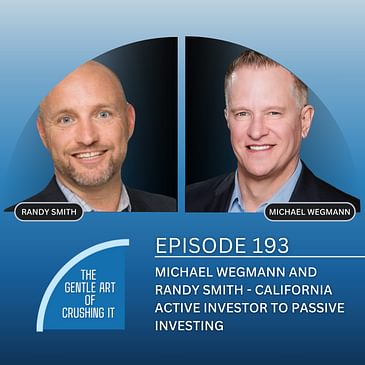
EP 193: Michael Wegmann and Randy Smith - California Active Investor To Passive Investing
The Gentle Art of Crushing It!April 25, 2024
193
00:29:5727.43 MB

EP 193: Michael Wegmann and Randy Smith - California Active Investor To Passive Investing

MICHAEL WEGMANN, MBA

After building a real estate portfolio of over $32M, Michael Wegmann founded Wegmann Investments because he saw the highest return on 100+ apartment complexes in Texas and Arizona, and other “landlord” friendly, no rent-control states. That’s when Michael found Rise 48. Michael founded Wegmann Investments so that his family, friends clients could earn high returns from apartment flipping and syndication. After 28 years of Real Estate experience in California of “flipping” 5 homes and 11 apartment complexes in RENT CONTROLLED cities, he began to look for more profitable cities. With an MBA, a real estate license and having flipped 16 properties, Michael immensely the flipping process and how Rise 48 is the best in the Nation. Prior to Wegmann Investments, Michael worked at IBM, Paramount Pictures Interactive and co-founded Math.com, the World’s Most Popular Math Site.

RANDY SMITH

Connect with our host, Randy Smith, for more educational content or to discuss investment opportunities in the real estate syndication space at www.impactequity.nethttps://www.linkedin.com/in/randallsmith or on Instagram at @randysmithinvestor

[00:00:00] Hello and thank you for joining us today on The Gentle Art of Crushing It show, where we focus

[00:00:05] on learning and sharing with our listeners all there is to know about how to create success in

[00:00:10] our lives. This show stands on the shoulders of giants. Our mission is to empower and inspire

[00:00:17] our listeners to create the life of their dreams whilst having a blast in the process.

[00:00:23] Let's celebrate life together. Welcome to the show.

[00:00:26] Welcome back to The Gentle Art of Crushing It podcast. My name is Randy Smith and I am your

[00:00:34] host today. And I'm excited to have Michael Wegman with us today. Michael is the CEO of

[00:00:39] Wegman Investments. He's been involved in real estate for over 30 years. He's flipped 16 homes

[00:00:46] and now he's doing something similar to what I am doing. So Michael, welcome to the show.

[00:00:51] Thank you, Randy. I appreciate it. Glad to be here.

[00:00:55] Outstanding. Well, let's jump in right away. Michael, can you tell the audience a little bit

[00:00:59] more about yourself and how you found yourself in this space?

[00:01:04] Great. Right. Well, I've got a technology background. I worked for Paramount Pictures

[00:01:09] Interactive originally and then broke off and started my own software company, Math.com,

[00:01:15] and created the world's most popular leading math site. And that was my technology background.

[00:01:22] That was a great opportunity, sold the company and then got into real estate. I read Robert

[00:01:29] Kawasaki's book, Rich Dad Poor Dad, and really saw that real estate owning an asset that

[00:01:37] produced revenue and typically appreciates in value as kind of a really great investment.

[00:01:43] So that got me after technology into flipping homes. So I flipped five homes and kind of

[00:01:51] did it, you know, seeing all the remodeled on home TV, how glamour it was, how great the

[00:01:58] returns were, which there can be there. But I quickly learned through a mentor

[00:02:04] that flipping houses was a higher risk, more stress because it's empty. You're not getting

[00:02:11] rent. You're much more susceptible to interest rates. Also, it's very competitive.

[00:02:19] And I found that multifamily was a better opportunity because, you know, the things

[00:02:25] that are risky in home flipping aren't as risky in flipping a multifamily because you

[00:02:31] can move one tenant out, have three tenants still paying if you've got a fourplex.

[00:02:36] And that's kind of where I started. I started with the fourplex, went to a fiveplex, eightplex,

[00:02:41] then eventually one of 12. And that's kind of my history. You know, flipping those apartment

[00:02:47] complexes multifamily was a much more profitable lower stress. It's based on your income. It's

[00:02:54] not based on a comp. So that was where I found kind of my roots. And then, you know,

[00:03:02] I'm in California, in Los Angeles, where it was partially rent controlled. But during COVID,

[00:03:08] it went 100% rent controlled. So I divested from my assets because it's just really difficult.

[00:03:16] It's landlord unfriendly. And with rent control, it's really difficult to flip a unit

[00:03:22] because tenants can stay as long as they want, as long as they're paying. And in fact,

[00:03:27] in Englewood, where I own one of my last properties, you know, I have to pay a $2,000 fee

[00:03:32] for having rents that are above market. So it's kind of adding injury to insult. So

[00:03:40] that makes me want to get into syndication syndications nationally with partners.

[00:03:57] If this sounds like you, check out impact equity.net and schedule some time to talk with

[00:04:02] the founder, Randy Smith. Randy went from massive income to leaving his W-2 through

[00:04:07] passive income. And he can help you do the same www.impactequity.net.

[00:04:14] Got it. Got it. Okay. So you started flipping single families after it kind of interesting,

[00:04:20] the technology piece too. But you started with single families and then you started flipping

[00:04:27] multi-tenant investments. So four-plex, six, eight, 12, you said. Yep. Apartment complexes.

[00:04:35] And so with those, did you, were you, how long were you holding those assets? Was it a true

[00:04:41] flip like you'd buy and renovate and sell or were there years that you were holding those?

[00:04:46] Yeah. My initial ones I held, I built a portfolio of $30 million just kind of by

[00:04:51] tooth and nail. I'm a real estate agent, so I would get my commissions,

[00:04:57] roll that into buying a property. And my initial properties I held, I would basically,

[00:05:04] over time, since there was rent control, I would get the tenants, eventually it'd move out

[00:05:10] and then remodel the unit and increase the rent property anywhere from 50 to 70%.

[00:05:16] And then I held those properties and then I would take money from that asset,

[00:05:22] take equity out and buy another one. So I wasn't reading as many books as I should have,

[00:05:30] knowing I should have probably sold the property, done the 1031 exchange

[00:05:34] and gotten bigger, better. But I was just building my portfolio thinking that's the way

[00:05:39] to do it, kind of the slow, earnest way. But then as you kind of talk to mentors and read books,

[00:05:46] the better way to do that was actually flipping properties. But again, in California now with rent

[00:05:52] control, it's just, it's really difficult to do that. You're at the mercy of the tenants

[00:05:57] who have a lot of rights. Got it. Got it. Yeah. So that's interesting. You hear a lot

[00:06:04] of people that will buy assets and they do kind of what you said is they will just do cash out

[00:06:10] refis every three to five years or so, which essentially is creating really tax advantaged

[00:06:16] income for you as the operator or the owner. But when you come to sell those on the back end,

[00:06:23] if you've been pulling money out that whole time, it does create

[00:06:27] quite the tax situation for you once you do sell those. Is that true?

[00:06:32] Yeah, that is. That's declared as income. So instead of selling the property and doing a

[00:06:40] 1031, which is much more tax advantaged or doing what's called a DST, a Deferred Sales Trust,

[00:06:48] but the 1031 is a much more financially popular transaction for flipping an apartment complex or

[00:06:58] you know, an investment property. Got it. Okay. So you, I think you mentioned that you sold all

[00:07:05] of those assets and now you've become a passive investor as well. So did you 1031 those assets

[00:07:12] into passive investments or did you just take the tax hit when you did those?

[00:07:18] Great question. I've sold all my properties but one investment property. Instead of 1031,

[00:07:26] I've done what I mentioned before, a Deferred Sales Trust, which is much more flexible. Instead of

[00:07:31] rolling it into an equal or greater property value, a Deferred Sales Trust, you can actually

[00:07:37] break up say you've got a million dollars to play with. You don't have to put that entire

[00:07:42] million dollars into a new property like a 1031 exchange. You can actually divide that up into

[00:07:48] 100,000, 100,000, you know, have 10 different units of investment. Some could go into a

[00:07:55] multifamily investment syndication across the nation. You could put some in the market,

[00:08:01] you know, traditional Wall Street, you know, Google, Facebook, you know, Tesla

[00:08:06] and you can even cash out some. So if you've got an event where you're taking out $100,000,

[00:08:12] it's tax on that only $100,000. The remaining $900,000 that's invested is still tax deferred.

[00:08:20] So I'm really excited about the Deferred Sales Trust versus a 1031. It's got a lot more flexibility.

[00:08:28] Interesting. Now, I think I had an operator come on and he talked in great detail about DSTs

[00:08:36] and I'm involved with another passive investing community where I hear people talk about

[00:08:41] one of the drawbacks can be that there can be some significant fees involved with DSTs.

[00:08:48] What has your experience been with this? Has that been your experience?

[00:08:52] The Deferred Sales Trust manager charges a 1% fee for that management.

[00:08:58] And then the broker who advises on the investing, you know, into the stock market

[00:09:04] or other places to put it for funds that they are responsible for investing,

[00:09:09] it's another 1%. But, you know, after the relationship and the money I have,

[00:09:14] I've got that down to 0.65%, which, you know, the grand total between the...

[00:09:20] Yeah, it's the total with the trust manager and the broker who's actually placing the

[00:09:27] investments, it's 1.65% a year, which I find that very manageable versus, you know, the

[00:09:34] tax event that you would have if you actually took that money out.

[00:09:38] Sure. Yeah, and being a guy in California, you're getting state tax, federal tax,

[00:09:45] they're basically going to get half of the money if you were to have that taxable event.

[00:09:49] Interesting. Okay. Well, very good. So you've decided to

[00:09:55] disposition those, get rid of those assets. You started investing passively. Talk about

[00:10:01] that journey, if you can, a little bit. What did that look like moving into the space? Did

[00:10:05] you one day just wake up and decide I'm going to sell all these assets and start

[00:10:09] leveraging this DST? Or was that a long gradual process? And what did that due

[00:10:14] diligence process look like when you first started?

[00:10:17] Thank you. That's a great question also. What happened was, is that, you know,

[00:10:22] I was looking at my turn in investment returns, and I was getting like 10% to 12% a year,

[00:10:28] which is secure because it's real estate. I knew what I had been doing for years, so I

[00:10:34] was very confident in that. But again, with rent control, the landlord unfriendly state of

[00:10:40] California, I started looking outward and that's when I found the Brad Sumrock Group,

[00:10:46] which is a, you know, he basically teaches individuals how to syndicate.

[00:10:52] And within that complex, I found, you know, being 60 years old, I really don't want to

[00:10:58] syndicate myself anymore. I'd done two of those myself previously in my real estate experience.

[00:11:04] But with this group that I had found, I found syndicators who were some of the

[00:11:09] best across the nation. And just through networking, you know, I looked at about

[00:11:15] a dozen different syndicators and evaluated them and found the best ones. And then I got

[00:11:22] a lead on to Rice 48 with Bikron and Zach, the founders of Rice 48. And I just found them so

[00:11:31] compelling. You know, they're vertically integrated with their own property management

[00:11:36] construction company. They buy supplies direct from China. And I'm like, these guys really

[00:11:42] know what they're doing. And they've just got an incredible track record of turning things

[00:11:47] around. I like their aesthetic, having flipped homes and my own apartments. I think you've got

[00:11:54] to have the right aesthetic. And they've got their nailing it both with branding, signage.

[00:12:00] And to answer your question fully, you know, it took me probably two years to sell the

[00:12:05] properties that I had. And now I'm investing in passive investing in a Rice 48 and then

[00:12:11] looking beyond that as I grow my portfolio and wait a minute investments that I started

[00:12:16] about a year and a half ago. Fantastic. Yeah, it's, you know, my story is somewhat similar

[00:12:23] to yours. I didn't buy the volume that you did, but I certainly bought my share of single

[00:12:28] families and was heavily involved and dealt with all the construction management on all

[00:12:33] of those assets. And when I started doing the math about return on equity, it was a

[00:12:42] sad day in the Smith household because my return on equity was nowhere near where I wanted it to be.

[00:12:49] And I started that slow process of selling the assets and then starting the due diligence

[00:12:54] process to move over into the passive investing space. So now what I found is that there are

[00:13:01] so many different operators out there. And I think you hit the nail on the head. Rice 48

[00:13:05] is a fantastic operator. I partner with them. I've invested very heavily with them as well.

[00:13:11] But they have a very unique business strategy that they leverage. And it's a very,

[00:13:17] you know, ideally it's a very quick flip when they're buying these units. They renovate them,

[00:13:23] they increase the rents and then they sell. There's a number of different business models

[00:13:28] in this space. I'm curious why you liked the Rice 48 business model compared to

[00:13:35] maybe some of those other operators that might hold them longer or do the infinite

[00:13:39] return model that you're seeing so many pop up with right now.

[00:13:46] One answer is I like the return. I like the return that they get. I think their first 11

[00:13:53] deals that have gone full cycle, they've more than done a 2X return in less than 18 months.

[00:13:59] So they really have it dialed in. Some of these people hold longer. They remodel

[00:14:06] and turn the units slower. I don't see a need for that. I see what they call forced

[00:14:11] depreciation where you get in, remodel the units, rent them out for higher rents.

[00:14:17] And the market can hold it with the equity multiplier. It's time to sell. And they're

[00:14:25] primed to do that and they're great at doing it. So yeah, I'm a big proponent of Rice 48.

[00:14:32] Yeah, no, I agree with you. I agree with you. I think they have an excellent business model.

[00:14:37] The fact that they're vertically integrated with both their property management and construction

[00:14:42] management allows them to control as much of that business model as possible, which you know

[00:14:49] being an operator like property management, construction management is critical to the success

[00:14:56] of the project. So let's shift a little bit. You've started to move into the space where

[00:15:04] you're sharing your experience now with your network and your friends and family and starting

[00:15:10] to build a larger network as well to make these type of investments available to a broader

[00:15:15] population. Talk to me a little bit about that strategy and why you've made the decision to

[00:15:21] move in that space. Well, with the good and bad of it, I turned 60 in June of this year. So

[00:15:30] I've kind of done the flipping of homes and I've done the apartment flipping. I've dealt

[00:15:34] with tenants. I've kind of done that whole tenants, termites, trash, toilets, which

[00:15:42] it's an experience. You've got a good return on it. But now I find that I can actually make

[00:15:48] as much or better return investing in RICE 48 who they're in the hottest market. Unlike California,

[00:15:54] which has high taxes, lower growth rate, lower job growth rate and population growth rate,

[00:16:01] they're in the hottest top five metro areas in the nation. So it's just a great place to be.

[00:16:09] It's not like there's a few hundred thousand to remodel these apartments. There's like over

[00:16:14] two million in Dallas, Fort Worth and Arizona alone. So this model is going to be around for a while.

[00:16:21] I like investing in it because I've done it. It's something I know. I know how to flip homes.

[00:16:26] I know how to flip apartment complexes. I've made a lot of money in it. And it's something

[00:16:32] I know when you know it, you know that it's traditionally a lower risk with a higher return.

[00:16:38] So that's kind of where I'm at. And allowing friends, family, colleagues

[00:16:45] to kind of tap into my experience and hopefully they trust me to get into this

[00:16:52] flipping syndication that's so hot in the Sun Belt, in Houston, Dallas, San Antonio,

[00:16:59] Arizona, some in Florida, where there's no rent control and it's a better tax advantage.

[00:17:07] It's landlord, what they call friendly, allowing the landlords to have more control in the process

[00:17:13] and the syndication and flipping. Yeah. Quite often the exact opposite of what you had

[00:17:20] in California, right? So yeah. Thank you. Yes. Yes. Yeah. Until it opened my eyes,

[00:17:28] I was just getting the bloody nose here in California, turning a good profit, which was

[00:17:32] nice. And in my head I was like, this is the best. But now I can see I can actually earn more

[00:17:38] by investing in Rice 48 or other syndicators who are in a much more hot market and like you say,

[00:17:45] have greater control, controlling the property management, the construction company.

[00:17:51] I was at the mercy of contractors, right? Which some days they come, some days they don't.

[00:17:58] Sometimes they get proof of permits, sometimes they don't. So, you know, Rice 48, there's low

[00:18:04] risk because they're just rehabbing units or rebranding, right? They're not doing ground up

[00:18:09] construction where they're having to deal with permits and city. And they also keep the revenue

[00:18:15] coming in from tenants. If you're doing a ground buildup, you have no revenue. So

[00:18:21] if something happens with the city or permits, you're sitting vacant, empty. And like you said,

[00:18:27] carrying a house, like on a house you get, say you sell it for two million, you bought it for

[00:18:31] one million. It looked like a $1 million profit when you have your carrying cloths,

[00:18:36] your construction, your materials, your time, you know, quickly your roads.

[00:18:43] Yeah, very good. Very good. Well, let's dig into this market that we're both operating

[00:18:50] in today. And I'm curious your thoughts about the economy and interest rates and how all of that

[00:18:58] is impacting the multifamily space. Do you think now's a good time to be buying assets or

[00:19:04] would it make sense to sit on the sidelines longer? That's a great question. You know,

[00:19:10] I think the market is adjusting. You know, with the seven hikes in interest rates, I think

[00:19:15] we've seen, you know, a pretty strong adjustment that's got to occur. Prices,

[00:19:20] you know, are coming down. If you look, you know, what's selling now versus a year ago,

[00:19:26] there's a 25% discount because, you know, with the rates, people's buying power is just not

[00:19:32] there. So I still think it's a good time to buy. You know, real estate can be cyclical.

[00:19:40] In two to five years, which is the average whole time for a cycle on a syndication apartment

[00:19:46] complex deal, the market will be back. You know, it just happens. And then we talked about

[00:19:54] this before with forced depreciation where you go in, remodel the unit and you force up rents

[00:20:00] anywhere from 40 to 50%. The property's automatically valued more. So you might have

[00:20:06] to hold the property longer. I don't think you're going to get a two year flip like the

[00:20:10] Rise has done in their first 11 deals, but I still think the model's there.

[00:20:17] If you look at the model they've built, which I know you're a real detailed guy from

[00:20:21] what I've heard, Rise has planned into their model cap rates with the banks. So

[00:20:30] they make sure that, you know, if interest rates do go up, they've got about a 2% spread

[00:20:35] where they're not going to be on the hook for that cap rate or interest rate that's gone up.

[00:20:41] So I think it's still a great time to buy. I think a year and a half, two years ago,

[00:20:46] if you got in, you're really having some struggles for these syndicators who have.

[00:20:52] But I think now is a good time. I would be cautious, conservative. I would look at the

[00:20:58] deal to make sure they've got good amount of reserves. They're not overextended with the

[00:21:02] heavy loan and go with the syndicator who has a great experience like Rise 48.

[00:21:10] Yep. Yep, absolutely. I think the people that are getting hurt today are the ones that either

[00:21:17] one they bought two shorter rate caps or they didn't buy the right rate caps

[00:21:21] and they're being forced to sell today. And unfortunately, investors are losing money

[00:21:26] because of that. We're seeing operators walk away from assets.

[00:21:31] Yeah, or they're having a capital call, having to put more money in. And a lot of people don't

[00:21:37] want to do it. So some of these are fire sales and collapsing. Yep. Which makes great

[00:21:44] opportunities for folks like Rise 48 and other operators to step in and pick those up. So

[00:21:50] very good. I think it's an interesting time. I think now is the time to be buying assets.

[00:21:54] As you mentioned, 20%, 25% discount compared to a couple of years ago.

[00:21:58] And over time, I think as we see the interest rates start to come down, even if it just takes

[00:22:04] the next six to nine to 12 months for those to come down another 50 or 100 basis points,

[00:22:09] that will drive the value of these assets up. It will take some of the dollars that

[00:22:15] are sitting on the sidelines and bring that back into play. And we keep hearing this saying

[00:22:22] that it started out as survive to 25, and now I'm hearing survive through 25. So I think we're

[00:22:30] going to be latter part of 25, early part of 26 before we see a lot of these assets really

[00:22:35] start to turn. So very good. Now, I know multifamily has been kind of at the core of

[00:22:43] your interest, but are there other asset classes that you like? Are there other debt

[00:22:47] instruments or investments that you're personally looking at and staying close to with your own

[00:22:52] personal dollars? Or is it all multifamily? Right now, it's all multifamily. Like I've said,

[00:22:58] it's my experience. It's what I know. So the last year and a half, I'm really just

[00:23:04] priming and pumping and showing that multifamily and syndication is the way to go

[00:23:09] given my experience. So I think that leverages my trust with my family, friends, colleagues.

[00:23:16] I think I'll branch out after that, but I really want to specialize and hone in on this initially.

[00:23:23] Fantastic. Fantastic. Well, very good. Well, I know that I do have a few questions that I like

[00:23:31] to ask everybody before we wrap up our podcast, but is there anything you'd care to share with

[00:23:35] the audience before we jump into that? Investments.com or michaelatinvestments.com.

[00:23:40] That's a great way to reach me. I just think we've already talked about this, but it's almost

[00:23:48] always a great time to invest in real estate. Right now, there's like you said, 25% off. So

[00:23:54] this is a good time to be investing. I think survive through 25 is actually what's going on

[00:24:00] because real estate will go up. It has its ups and downs. We had a really significant up

[00:24:08] in 2020 and 2021. I'm a real estate agent and that market was so hot.

[00:24:17] Some of my clients, we were over bidding by a half a million dollars and still losing

[00:24:22] even with an all cash offer. So real estate just like the book, rich dad,

[00:24:28] poor dad is always a great investment for the most part. Absolutely. Absolutely. Yeah. And very

[00:24:35] well said. What do they say? Don't wait to buy real estate, buy real estate and wait. Right?

[00:24:42] Yeah. Any significant amount of time, the value of that asset will go up.

[00:24:46] Yeah. And you don't get rich quick, but you get rich.

[00:24:50] Absolutely. Very good. Very good. Well, good. Well, let's hop over into the final section

[00:24:56] of the show where I ask just a few questions of everybody we have on the show. Can you share

[00:25:03] a specific educational resource with the audience that would help them on their journey to

[00:25:09] becoming a new or newer passive investor? Sure. There are multiple syndication books

[00:25:17] that are on the market, apartment syndications. I would look at those.

[00:25:21] There's a book by Brian Burke, which is the passive off investor. I'm not sure if

[00:25:29] I'm getting that title correct, but hands off investor. Yeah. Thank you. Thank you.

[00:25:36] I would educate yourself through that even going to some seminars like the Brad Summark group.

[00:25:42] They have seminars for $99 for two days on the weekend. You can do it virtually or in

[00:25:47] person and educate yourself on how do you vet a syndicator? What to look for their experience?

[00:25:54] Are they vertically integrated? Have you ever had a capital call? Just things to ask yourself

[00:26:00] to make sure that you've kind of buttoned down your questions, to make sure you're going with

[00:26:05] the syndicator that is experienced and has done well. Love it. Love it. Yeah. I like that you

[00:26:14] share those two-day conferences that you can even do virtually and learn almost everything

[00:26:20] you need to know to be a good passive investor or pair up with somebody like yourself or others

[00:26:26] that are helping people with that process. Very good. Now, is there a recent bucket list

[00:26:35] item you've checked off your list or one you hope to in the near future?

[00:26:41] Thank you. I have twin daughters that are graduating from high school. My husband and

[00:26:46] I are taking them to a Europe trip. We're flying into London, then to Paris and Amsterdam.

[00:26:53] We're doing that this summer for two weeks. That's a big bucket list for

[00:26:56] myself, my family, and my daughters. Yeah. Fantastic. My wife and I might do

[00:27:02] Amsterdam and Germany in the fall as well. Very cool.

[00:27:07] One of my dreams is to attend Wimbledon. I'm not sure we'll hit this trip but

[00:27:12] that's on my bucket list too. Fantastic. Yeah. Well, very good. Then the final question I'd like

[00:27:19] to ask is if you had $100,000 to invest today but you could not invest it in one of your deals,

[00:27:27] where would you place that capital? I'm actually investing in a

[00:27:33] gold and silver mine up by Baker's Field, California. They've already done one round

[00:27:39] and it was an old mining mill during the 40s. They had a lot of minerals that they found.

[00:27:50] They were gold and silver. It was sold just for the price of land value and I got in on the deal.

[00:27:56] Now they've dug deeper, they've done all the drills and they found a lot of gold and silver.

[00:28:03] There's a second round. The eventual outlet there is selling to a gold and mining company

[00:28:10] or doing an IPO. That's where I'd put, and probably early next week, putting more money in

[00:28:17] there. Fantastic. Yeah. You don't hear that often. Very good. No, no, no. I don't think

[00:28:24] I've ever heard of the 100 plus episodes I've done. I've never heard gold and silver so

[00:28:29] that's interesting. Yeah, very good. Yeah. The price of gold could be strong.

[00:28:36] Yeah. It seems like it's correlated to the market but opposite of the market generally so

[00:28:43] that's interesting that it's doing well now. Yeah. Yeah. More of a security. Very good,

[00:28:47] Michael. Well, thank you so much for being on the show today. I appreciate you coming on and

[00:28:52] sharing your story with the audience. It's been good to get to know you again and excited that

[00:28:58] I'll be working alongside you with a lot of these projects with Rise 48. Michael,

[00:29:03] thanks so much for being on the show. I appreciate it, Randy. Thanks for the

[00:29:06] opportunity and yes, great to talk to you. Awesome. Well, very good too. Our audience

[00:29:13] as always, we encourage you to continue that education journey. More important than that,

[00:29:17] though, make the decision to start passively investing. Both Michael and I are convinced

[00:29:23] that once you do, you wish you would have started that much sooner. Be sure to join us

[00:29:28] again next Thursday for another great episode and thank you so much for joining us today.

[00:29:53] Magnificent. Thank you and have a wonderful day.