
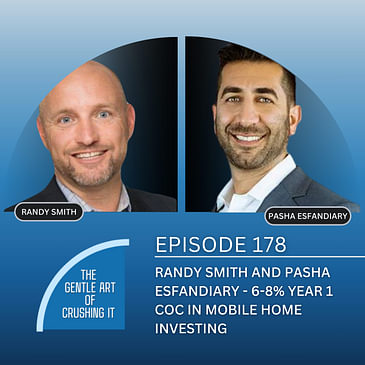
EP 178: Randy Smith and Pasha Esfandiary - 6-8% Year 1 COC in Mobile Home Investing
Starting his career in real estate in 2011, flipping homes found at auctions, Pasha has since been involved in over $250 million in transactions across multiple asset types. These include residential homes, boutique motels, the purchasing and management of large multifamily properties, and working with housing programs in vulnerable communities.
In early 2021, Pasha founded Evoke Capital with the primary objective of helping others achieve financial freedom through real estate investing. His lifelong philosophy is what drives Evoke Capital to excellence – People First. Treating each investment as his own and each tenant as family, Pasha has developed Evoke Capital within 24 months to include a portfolio of over 1450 units.
Throughout Pasha’s successful professional ventures, the unfolding of his dream focuses on his value of sustainable community development. This goal in building low-income housing is to provide much more than a roof overhead. The future includes an NGO where all the Evoke properties provide nurturing and interconnected community for his residents. The plans are for valuable educational resources within finance, nutrition, and emotional intelligence. Pasha is committed to building an environment that empowers and encourages its residents to grow, achieve and thrive.
With over ten years of experience and a commitment to growth, it is no question that Pasha and Evoke Capital are just at the beginning of their real estate journey
HIGHLIGHTS IN THIS SHOW:
00:00 - Intro
01:41 - Background
04:36 - Poker
08:48 - Vegas Market and Flipping
12:10 - Mobile Home Parks
16:15 - Cashflow
19:29 - Lenders
20:24 - Deal Structure
24:40 - Market Trends
30:00 - Passive Investments
31:34 - Evoke Capital
32:50 - Due Diligence
36:00 - Final Thoughts
CONNECT WITH OUR GUEST:
CONNECT WITH OUR HOST:
Connect with our host, Randy Smith, for more educational content or to discuss investment opportunities in the real estate syndication space at www.impactequity.net, https://www.linkedin.com/in/randallsmith or on Instagram at @randysmithinvestor
----------------------------------
Follow us on social media @the.gentle.art.of.crushing.it
Listen, like, subscribe, comment: http://thegentleartofcrushingit.com/
[00:00:00] People do it because it's a higher cash on cash, right? So I get it. But I think for scalability and for long term, I think the right move is to just have it so it's all tended on home. Hello, and thank you for joining us today
[00:00:15] on The Gentle Art of Crushing It show, where we focus on learning and sharing with our listeners all there is to know about how to create success in our lives. This show stands on the shoulders of giants. Our mission is to empower and inspire our listeners
[00:00:31] to create the life of their dreams whilst having a blast in the process. Let's celebrate life together. Welcome to the show. All right, welcome back to The Gentle Art of Crushing It podcast. My name's Randy Smith and I'll be your host today.
[00:00:49] And I'm really excited to have a guy that I've been listening to his podcast and kind of watching him around a community that we're both a part of. Glad to have Pasha Esfandiary on the show with us today. Welcome. Thank you, Randy. I'm excited to be here.
[00:01:03] I hope I don't bore you with my podcast. No, no, no, not at all. I actually loved it and that's really what inspired me to reach out or was excited to see when you raised your hand on this. So yeah, maybe can you just tell the...
[00:01:15] Actually, I was supposed to do an intro. So real quickly, Pasha is a co-founder of Evoke Capital. They focus on mobile home community syndications. He's been investing in real estate for over 10 years and he's also a podcast host of The Road to 100. So that's my brief introduction,
[00:01:34] but Pasha, can you tell the audience maybe a little bit more about yourself and how you got to be a mobile home operator? Oh man, where do I start? I think it's really pertinent to say that before my career in real estate investing,
[00:01:51] I started as a poker player. I went the non-traditional route. I went and played poker professionals for many, many, many years, traveled the world, did wealth kind of through the initial bankroll that I had into my first deal that I did side on the scene auction.
[00:02:10] And I made all the mistakes that you could ever imagine, but I still netted $3,000. That is free tax. And I just, I caught the bug and I just said, hey, there's something here. I've always wanted to be in real estate. Poker for my lifestyle wasn't working.
[00:02:26] It was just an added kind of income for me at that point. And I just really went a deep dive into just flipping homes in Vegas. Moved to Los Angeles about four years later, three to four years later and started to, I flipped one home here
[00:02:44] and I really saw an opportunity in a path of progression bought up all the land in LA in that area that I could and started developing on there, even though I've never developed before. And so that was, I did that for about close to five years.
[00:03:01] And I said, hey, I'm about to have a family pretty soon. Let me start working on my passive income really, because when you're flipping and developing, you're really kind of going for that net worth number. And my goals have changed as I got an older
[00:03:14] into passive income, found multi-family and started going down that route. But I saw that the opportunity was exactly where I am now which is mobile home parks. And so I transitioned everything on my residential portfolio and threw it into mobile home parks. I stopped buying apartment complexes
[00:03:34] because I saw the opportunity in front of us. And I really went kind of head on almost about two and a half, three years ago, ran out of money, started at Evo Capital because the opportunity is too great in my opinion. And then here we are now.
[00:03:50] I never really thought I would have created a business out of this. I was always going to be just a private investor. But again, I asked myself a question in 10 years from now, will I regret not buying these? Yeah. Institutions are gobbling these up. And I said yes.
[00:04:06] So it's kind of happened under necessity. Are you interested in real estate investing but don't know where to get started or think you don't have the time or money? Are you stuck in your W2 because the golden handcuffs make it hard to walk away?
[00:04:20] If this sounds like you, check out impactequity.net and schedule some time to talk with the founder, Randy Smith. Randy went from massive income to leaving his W2 through passive income and he can help you do the same. www.impactequity.net
[00:04:37] So I've got about 12 questions just from that intro and kind of a silly one. First of all, Annie Duke mean anything to you or a book that she wrote? Okay. Did you know Annie Duke by any chance or? I've had dinners with Annie Duke in auxiliary.
[00:04:54] It's not like we've connected. I don't think she would remember. She knows my brother really, really well. My brother being one of the winningest poker players in the world. Oh, yeah. So I know a lot of people through that. In my poker career though,
[00:05:10] I always try to keep underneath the shadows, right? I just, I don't like to be in the limelight. Never did when I was younger. I still have a hard time being on podcasts and being out in front. And I just played a lot of cash games.
[00:05:25] And so, yeah. So yeah, I think, and I don't remember the name of the book betting. Don't remember the name of the book, but anyways. What is it? I know the concept. I don't know the name. Okay. Yeah, and I remember there,
[00:05:37] it's essentially just, it's a numbers game obviously much like any investing is. So do you think your time as a poker player has helped hinder do, meaning adjustments to the way that you invest or? There's been some hindrance. Mostly it's been a massive net positive.
[00:05:54] I would say that the biggest hindrance is when I first started my real estate career, going transitioning from playing poker to the real estate world and making like money in the real world way. You know, cause I made 3000 net, right Randy?
[00:06:08] But I used to bluff that off easily and three times more in one hand. And so starting to understand that in the real world, it is really hard to make that kind of money. And so I just had to get a little tighter.
[00:06:22] So that was the only really kind of like difficult transitional period for that year. Yeah. But I'm actually writing a book right now which should be released probably by the end of this year about all of the lessons I've learned in poker that have translated into investing
[00:06:38] and how I look at life and how I do think in numbers and probabilities and bets and all of that stuff. Yeah, awesome. Yeah, no thanks for going into that cause I think, you know, I've always been a numbers guy myself. I used like as a child,
[00:06:52] I used to say that I could see math solutions in pictures for some reason which people don't really understand that. But it seems like in the real estate investing space there are, there's a lot of unknowns where it seems like, you know, in poker
[00:07:06] like the percentages are the percentages. But I guess to a certain extent you could bring that into the investing as well where, you know, due diligence is due diligence and insurance and taxes and all of those expenses are all just pretty much the same.
[00:07:19] So I'm curious, is there more certainty or less uncertainty do you think in real estate investing space? 100% more certainty. You know, because poker is such a game of incomplete information. And so you're always, I think the reason why people are attracted
[00:07:35] to playing poker is because what it really does is it hones in on your decision making and how do you process different types of information and then to make just a rational kind of outcome. Right? And what I always try to say is that
[00:07:50] because poker is a game of incomplete information you're always at best slightly guessing, right? If you just kind of boil it down all the way but with real estate it's a game of, I would say that if you do your due diligence process, right, 99% complete information.
[00:08:08] There's always some surprises but again you can factor into your performance for that. You can add a lot of cushions once you have enough experience to understand that this, this, this, this all have to go wrong but I've already built it into my performance, right?
[00:08:24] And that's how I look at real estate. I look at real estate is everything will go wrong. That can't go wrong and if it doesn't then great. It's just extra gravy for my IRR numbers and all that. So yeah. And if you're conservative on the front end
[00:08:38] then just like you said, it's kind of a straight back up. You make money on the buy. There's some simple rules in real estate that I think people get ahead of themselves. You make money on the buy. It's that simple. Love it, love it, love it.
[00:08:50] So now you did flipping in Vegas which I think there's a show called Flipping in Vegas and I spent some time in my career flying into Vegas every other week and Vegas is very, very competitive. It's unlike any other market I've ever seen before.
[00:09:06] I'm curious how did the Vegas market compare to what you've seen in LA and now what you're seeing in some of the other markets? So when we're talking about residential I have to remind you that I started to flip around that 2010, 2011 period.
[00:09:22] And I bought from the auction at the trustee sales. So side unseen and you really don't know. And so that I guess that's really essentially why now my performers have so much cushion in them because when you buy from side unseen
[00:09:36] you just have to make sure that you're covered on all the angles and it's a numbers game, right? Yeah. And so the market was really good. And then as we progressed closer to when I moved to Los Angeles they changed the laws.
[00:09:53] You used to be able to buy a home in Las Vegas and then sell one at the 91 day mark. So you could get it in contract and let's say one, two but then they changed the laws because they wanted to prevent a preview not another 2008.
[00:10:08] And so they made it so that you can't even list the home until the 91st day which really kind of cut into the profit overall cause it's a numbers game. And so for a time it was really easy, right?
[00:10:21] Finding deals cause it was like a plethora of them. When I came to Los Angeles I was used to being a big fish in Las Vegas. I almost knew everybody. It's actually a smaller town than anyone, everyone thinks. And I come to Los Angeles
[00:10:34] and I am just a completely small fish in a huge massive ocean. And the competition was so stiff. It was so hard to pencil out a deal from it because again, I was just waiting for the right opportunity where I have a lot of cushion
[00:10:48] but I was just getting beat out by all cash offers left and right even though I was all cash too it was whooping you know but they had their systems they had their bigger players so that's why I went into development.
[00:11:00] I saw an opportunity, it's more niched down and I don't know how that thumbs up came up. I'm not sure where it's coming from yet. And then, and so then I started developing because there was less competition and more reward.
[00:11:14] It's kind of how I followed my whole career even in poker game selection. I never wanted to play with the best players. I never wanted to play with my brother always beat me. I always just wanted to play in games with people who are worse than me.
[00:11:28] And so that's again why I got into mobile home parks. There's the biggest stigma into it. There's less competition and it's harder work but the harder the work is up front the more you get rewarded in the back end. I love it. Yeah, so there's this period though
[00:11:47] where you moved from flipping to doing was it infill development in LA or was it? It was in LA or? It was a hillside ground up construction. Okay, smaller community stuff? Yeah, yeah. I mean the max we would build is a 2000 square foot home.
[00:12:05] And it was essentially in that market luxury homes in that market. So. Got it, got it. Okay. Yeah, and so then you see this opportunity I think to quote you from earlier you said the opportunity was too great not to go I'm guessing bigger faster.
[00:12:22] So what did you see there? Because you did some multifamily and you did the development stuff. So what kind of caught your eye or what steered you towards this new path that you at least saw initially? Sure, you know, first thing is first
[00:12:38] I think once I started really evaluating the mobile home park space it's in my opinion the only sector of commercial real estate that the supply is dwindling because we're losing more mobile home parks and we are building them. And the demand is increasing.
[00:12:56] We understand that we're always going to be printing money in all of the governments across the world inflation is going to keep happening and what happens is the middle class keeps getting squeezed and there is no good solution for low income housing.
[00:13:07] Whatsoever, I tried the light tech route it's actually very cumbersome and I actually would argue it's not really for low income families at all. And so it is the only commercial real estate that I thought that on a long term scale the demand is going to keep increasing.
[00:13:26] And so I said, okay, well there's that I like the market trend of it because I like betting in 10 years that's how I look at my life I'm always at least 10 years planning backwards. So I said, okay, I like that aspect I like high cash flows.
[00:13:40] Okay, it gives me higher cash flows than multifamily where I'm a cash flow investor I want to build up my passive income it's my fastest way to get to my goals in passive income, it's mobile home parks. And then really at the end of the day as well
[00:13:55] you can combine it with a higher depreciation than multifamily, right? Because on multifamily you have a 27.5 or 29.5 scale to depreciate your asset on and in mobile home parks it's 15 years so you get double the depreciation which is great for high income earners. And then lastly, another reason
[00:14:16] why I sprinted towards this is that I'm still buying from mom and pop sellers. Like, if you look at mobile home parks as a niche I'm a niche within a niche. I am buying secondary tertiary markets 50 to 150 units at most.
[00:14:31] We would buy bigger but we just haven't seen anything cross our way that pencils out. And we're still buying from badly operated mom and pops and in five years from now that will not be the case because more players like myself more sophisticated buyers smarter money
[00:14:48] is coming into the mobile home park space and gobbling up all of these properties. So that's why I said I have to sprint towards this opportunity. Interesting, okay. Yeah, that makes a lot of sense. It seems like we've seen a shift from multifamily into self-storage into light industrial.
[00:15:07] Obviously enough my first passive investment was in mobile homes before I knew really anything about passive investing. But it's interesting that you're choosing that small niche which I think the smaller generally the higher the cash flow as well. So I think that's smart.
[00:15:24] Certainly when you're buying from mom and pops you're gonna see bigger opportunities for gains quicker I suspect. And as you scale and your systems get more complex and more effective then that just helps even more. Interesting, okay. So how many units are you guys at right now?
[00:15:43] We're right under 2000 units right now. Wow, okay. Okay. So we see, I'm curious you say high cash flow. I've seen that in my own personal investment but we see a lot of multifamily that's, you might see five or 6% in year one cash on cash. That's a good one.
[00:16:06] That's a very good one. Yeah, that's a very good one. Yeah, so more often like 3%, sometimes even zero for the first 18 months or so but what kind of cash flow can you see from these type of investments? And do you offer ultimately then to your investors I guess?
[00:16:22] Yeah, so I think one thing that really stood out that our investors liked is that we were able to hit in our fund we were able to hit that 8% preff right off the bat. Now, yeah it was very difficult.
[00:16:36] One metric that we look at in all of our deals is if we're not hitting double digit cash flow in year two, we're not buying it, right? And so, but what we're gonna change it up in fund two a little bit just because we had to pass
[00:16:51] on so many good potential deals that were lower in cash flows and that they're hit double digits but they were still hitting above a seven or eight in year two. Sure. We passed up on opportunities and I don't wanna do that anymore.
[00:17:06] So in fund two, we are gonna offer that kind of higher preff but cash flow might be six to 8%. On average what we're seeing across our portfolio when we bought them we're averaging about 6% to 8% in year one of cash flows because we're not big value add operators.
[00:17:30] We don't do a ton of infills. We are looking really for the badly operated properties that already have the homes on there and we just go in and fix operations and raise the rent and fix the roads
[00:17:41] and do all the things that a community needs to be safer and to justify our rents to hit those cash flows. Yeah. Okay, and then are you guys, I know there's this idea and I don't even know what the term is but where the operator owns some homes
[00:17:57] within the communities and some don't or they prefer not to, do you guys have a preference or a strategy you guys follow? Yeah, we do not wanna own the homes whatsoever. We will give them away if we have to. We've given away homes for free.
[00:18:13] We are not in an apartment complex. We don't wanna deal with toilets and sinks and all that. We will buy parks that have park owned homes but the plan is to always sell them off or RTO which is a rent to own. Okay.
[00:18:27] We just wanna own the roads and the utilities because what happens is in the beginning when you buy a mobile home park there's a lot of work to do. Especially, we're buying C-class mobile home parks and we're doing a lot of fixes to it
[00:18:42] and with that sometimes you gotta get the bad tenants out and so it's a lot of work up front but then after that we don't wanna have any headaches. We just wanna own the land underneath and let them pay a lot rent
[00:18:55] and that's what we try to do. Yeah. Got it. Okay. Yeah, I know it seems like I dealt with some tenants and toilets in my bird days and what was supposed to be turkey, it was terrible. Yeah, it's terrible. It's terrible. I understand why people do it
[00:19:10] because it's a higher cash on cash. Right? So I get it but I think for scalability and for long term I think the right move is to just have it so it's all tenant owned homes. Got it. Okay. And do lenders like this asset class?
[00:19:27] Are they friendly with mobile home communities? I'll tell you, I think a lot of banks don't understand mobile home park communities yet. We do work with a few national lenders who know everything about mobile home parks and typically in a region we can find one or two,
[00:19:44] three regional banks that know it well enough but we do find ourselves educating regional banks quite often about, hey, it actually works this way. So yeah, it's kind of an interesting... Kind of world when it comes to mobile home park lending. Okay. Well, yeah, there's certainly been,
[00:20:06] like looking at your history, you've kind of, you've spent a block of years at different asset classes and it's constantly progressing. And you mentioned three to five years from now it's likely that this will be kind of, all those will be scooped up.
[00:20:19] So where do you see the direction of a vote going at that point? I think with scalability, I really can't say. I don't think we're the company that we're gonna just buy deals just to buy deals. I mean, we actually set up everything
[00:20:35] so that way we charge very minimal fees and we just reward ourselves only on the backend once investors are paid back 100%. And because of that, we're not deal junkies, we're being aggressive but we're not deal junkies if that makes sense.
[00:20:51] So I don't know where it's gonna lead us. If it does lead us to other opportunities, what we're starting to find, I guess here's the best way to give you an example. Lately we've been seeing other operators who have tried to buy mobile home parks
[00:21:07] who are failing at operations because when cap rates have compressed they decided to get into mobile home parks and we're starting to see them, those kind of deals come back to us now because they need to get out. And so we're hoping that trend will continue.
[00:21:27] I could say pretty confidently, we're graded operations so I think there will always be opportunities. So we'll just grow with it but we'll see where it goes. I don't have a crystal ball, we're just not gonna buy deals just to buy deals because like I said,
[00:21:45] we're not the kind of operators who just make a bunch of fees. Got it. No, that makes sense. And it's nice to hear that as well. Like as an investor, you have to look at the full picture to see like what's the exit strategy, what's the long-term plan?
[00:21:59] Is this just a long-term cash flow play which is what a lot of us are looking for or is it somebody that's gonna try to spend these things quickly just to get all of the fees out of them? Right. I'm glad that you said that.
[00:22:11] All of our holds except for one syndication but every other property it's for an indefinite hold period. It is, okay. Oh yeah, indefinite hold period, full 100% refi back by year five. And like I said, we don't touch a dollar into investors or paid back.
[00:22:31] So we're incentivized to do well. Wow. Yeah. Okay. Yeah, and I've seen some groups that do a similar model and my concern is always that if you're, the operator's gotta make money as well. Otherwise, you know, so like you need to be making money throughout this product
[00:22:48] just to make sure the doors stay open, the investors get taken care of in the long run. So are there other revenue streams that are keeping a Vogue moving forward or is there? Yeah. I mean, so there is an acquisition fee. Okay. That's the fee that we charge
[00:23:02] and then there is an 8% property management fee. And really in the mobile home park space it's about for the markets that we're in it's eight to 12%. We charge 8%, we don't charge any lease ups or any extra work construction fees and all of that. It's very straight up.
[00:23:20] Our property management fees is basically a break even for us. And we're okay with that. We, I guess we all don't, I guess the best way to put it Randy without trying to come off as a cock or anything we've all done very well in our lives already.
[00:23:37] So we don't need the fees to make money and live. We have our previous investments. So we're building the company a way a company should be built. And we've structured this the way I would wanna be part of other people's deals. And I,
[00:23:53] and that's the way I created it on my funds. And so, yeah. No, thank you for sharing that. I don't know how to ask that question without saying do you guys have deep pockets or not have deep pockets? But, I don't want to say that.
[00:24:05] I just, I think we've, myself and my founders we've done well previously and investing already and we decided to kind of come together in this, you know, realm and keep doing this. So it's not like we're trying to nickel and dime.
[00:24:19] It's not like we're trying to get this 1% fee here or this asset management fee here, this 0.5 fee there because we see the longterm vision. Got it. Love it. Awesome. Okay. So, you know, uncertain times economic challenges that are going on, you know, for all the different asset classes
[00:24:38] at this point. So I'm curious if, if you had the crystal ball looking into 24 into 25 what do you see ahead of you guys right now? Are there headwinds that you're expecting or are you more optimistic at this point? I'm, I'm more optimistic at this point.
[00:24:55] I think there was a lot of people that were screaming doomsday scenario almost six months ago. And I, I always just said to everyone in my peers I think it's going to be more of a soft landing than everyone thinks. I think the government has proved
[00:25:08] that they're always going to try stepping and help as much as possible in the Fed will as well. I think interest rates will go down. But then, you know, the thing I keep going back to is we printed more money in the last few years
[00:25:19] than ever in our like our lifetimes or the earth lifetime. And so there's just so much money floating around and everybody that I knew anyone had money sitting on the sidelines waiting for a deal. And so I was, I always thought to myself
[00:25:36] that I don't think it's going to be that harsh. I'm also spoiled. I'm in the mobile home park sector and nothing changed for us, right? We all have, we have, we only have fixed debt. No, we had no variable debt.
[00:25:50] And so, you know, really nothing's been going on first and we're always so low, the low market rent anyways during this time we've been able to increase our rents. So I don't have a crystal ball. I don't like making predictions.
[00:26:04] What I will say is this to you and the viewers if you see a really good deal, go buy it. I don't care what time of the market it is. If you're going to be happy with that property 10 years from now, buy it.
[00:26:17] And that's the way we look at it. Yeah. You're not buying with the hopes of flipping this thing in two to three years. You're buying, if the numbers work today they're going to work in five years and 10 years and 20 years. That's exactly correct. Yeah, love it. Yeah.
[00:26:31] And I, what I love about mobile home is like people don't move out of mobile homes to some cheaper solution. Like, you know, you hear There is no cheaper solution. Right. You hear A classes move down, B classes can move up or move down.
[00:26:44] You're not moving down from mobile home. Like this is kind of a last street on the block, right? You know there's an awesome stat for mobile home parks is that 50% of all tenants in mobile home parks have lived in that home for 14 years and more. It's very non-transitory.
[00:27:01] It's very consistent across our whole portfolio. We may have one to two move outs every year. Wow. It's, it doesn't move out. Meaning they take the homes to another park or another competitor and park their home there. But it's very rare that that happens. So.
[00:27:21] It's pretty expensive, my understanding. It costs, you know, eight to $10,000 to move one just down the street, let alone any real distance. So yeah, that's interesting too. And I guess that factors into if you don't own the homes and they're not renting from you,
[00:27:35] then you're not gonna see a turn like that anyways because they actually own the homes and it's too expensive to move it. Interesting. Okay. Well, and so I'm curious, what does that do for your ability to raise pad rents? Or I'm not sure what the term is even.
[00:27:49] Do you guys do two, three, four percent annual increases? No. Typically we look at it this way. I think we have a firm belief inside of evo capital that all rents across the US at every mobile home park, at every low income spot should be at least $500.
[00:28:08] We are typically finding that we buy all of our properties that are in 300 lot rent as our average. We pro forma for about 30 to $35 per year. Some markets we've done $50, right? We're bringing it up to market rent and then we will decrease it down
[00:28:24] to about that three to 5% that will raise it. But also depends on the market. So this is again going back to the opportunity that we found a lot of these operators, mom and pop sellers haven't raised the rents accordingly to what the market should be.
[00:28:40] And so we're so well below underneath where it can be and it should be and what market really is. And so what I like to tell people is that, you know, it's really, we're dealing with smaller price points but we're dealing with higher ratios.
[00:28:57] You buy a lot rent at 300, you raise the rent for $30 per year. That's a 50% increase by year five. And by then you should also be reducing the repairs and maintenance down below that 30% threshold. So, you know, there's just a lot to like there. Yeah, yeah, I love it.
[00:29:13] Interesting. Yeah, well you got me excited about looking into this more and seeing what some investor decks look like with potential returns on these because I was not a cash flow investor or at least I didn't think I was a cash flow investor
[00:29:26] when I was a high income guy. But when you get laid off, all of a sudden you become a cash flow investor. So, I have learned that net worth means nothing. It's all about cash flow and what you have coming in. Yeah, yeah, absolutely.
[00:29:39] And that's a hard lesson to learn if you've got all your money tied up in five year syndications that are probably on hold as well as a lot of people have found in the last couple of years. Well, very interesting.
[00:29:53] So now I know you're a pretty heavy passive investor as well. Do you only invest in the mobile home space or are you investing in other asset classes as well? No, I'm pretty diversified. I think early on in my career I've invested in some businesses
[00:30:11] and that's a realm I don't know so I rarely invest in businesses anymore. But now I typically will invest some in multifamily some in self storage, some in some hard money lenders. I enjoy being a passive investor. I am a high earner but typically I would say about 85, 90%
[00:30:35] is all mobile home parks. It is, yeah. Yeah, it's what you know, it's where you see the benefit is. I just, it's hard for as a passive investor to make the returns I can make on even our own deals. So I'm the biggest investor in Evo Capital
[00:30:51] on the LP side, right? Because like I said, I just love our products and I stand by it. Yeah, and we love as investors, we love to hear that story because you believe in what you're doing and if you can go get better returns somewhere else
[00:31:05] then so could your investors, right? That's exactly right. We have a rule that in every syndication or every fund at bare minimum, we as the partners are putting in 10% on average it's more about 15 to 20%. Like we buy deals that we would invest our own money
[00:31:21] we structured the way that LPs should be structured. So. Yeah, very good. Well, this has been really interesting to learn about this and I'm sure our listeners will want to learn more how could investors hear more about Evo Capital and what you guys are doing over there?
[00:31:37] I think the best thing to do is I always say go to our website evocapital.net go to the investor login and sign up there and then it sends you an automatic email and there's a calendar link and you know happy to meet with you
[00:31:53] or anyone who signs up and just do a 30, 45 minute conversation. At the end of the day I find I do a lot of educating on what the mobile home park space is. I want everyone to be informed what we do, who we are.
[00:32:11] I don't want investors just to invest because other people invest with us. Love it. Yeah, great advice. I hear that and we're both in our in abundance and you hear people say don't take my recommendation as your due diligence.
[00:32:25] Always go out and do your own due diligence on these. So yeah, really great. And the fact that you're spending 30, 45 minutes with investors that says a lot about the type of organization that you have. Now you guys are doing funds
[00:32:38] or those primarily 506Cs or do you do any 506B stuff? So we did a 506B on our last fund. We are changing it over to a 506C moving forward. Yeah. Okay, yeah, very good. So anything else that we should have talked about
[00:32:53] in this space that maybe I didn't ask or anything you'd like to share with the audience that I might not have covered? I mean, I don't think off the top of my head. I think when it comes to due diligence for any investor
[00:33:07] I always tell everyone ask them a lot of questions. Just ask a ton of questions because the ones who keep answering over and over again are the ones that are gonna keep answering you in hard times as well. That's a great point. Great point.
[00:33:21] There's a lot of top 100 questions to ask a syndicator out there on Google. But it's interesting, I think, like even if as newer investors are getting into this space as they're asking those questions, I think you can tell a lot about an operator just simply how they respond.
[00:33:36] If you hear a guy that knows the answer to every single question, it doesn't say, you know that I don't know I might have to come back to you with that. I think that says a lot and you can actually get to know people pretty well
[00:33:46] just simply how they're responding to those questions. I think that's really good advice. I think, you know, my father always said something is that people are not stupid, right? Don't think you're gonna get over on them. And so I always take that advice really deeply to heart
[00:34:01] because what you put off, the energy you put off you'll get that vibe. So if you're looking for let's say in a friendship trustworthiness and authenticity look for that in an operator as well too. And yeah, I mean, I've seen a lot of operators
[00:34:18] that everything was too polished but I got a bad feeling about it. And it's served me well. Well, at the end of the day, Prash, if somebody's investing with you like this is not a one or two year relationship this is a seven, 10, 15, 20 year relationship potentially.
[00:34:36] And then, you know, that's one thing that really, really focus on is that I wanna grow with all of my investors. I am incredibly blessed because we get so much repeat investments with us. But, you know, one of the things that we do
[00:34:50] I think is a little different we've also raised on a per deal basis even though it's probably easier to just raise all that once and do all that we really do the things the right way to build this company
[00:35:00] cause I want everyone and every investor to grow with us. And that's the plan. We have a very long term vision we want our investors to keep growing with us. And so what, you know, our biggest feedback is we get really detailed quarterly updates every single quarter.
[00:35:15] We bring the K ones out on time the distributions go out on time. You can always call me and I'm always gonna be available I answer every question that's needed cause at the end of the day it's your money. I want you to feel comfortable.
[00:35:27] So, and I know my product and I stand by it. Awesome. Well, very well said. Well, thank you for that. I think you'll likely hear from a lot of listeners. This is a very compelling story compared to what we see with multifamily
[00:35:41] and self-storage some of the others as well. So, you know, I just encourage folks to reach out to Pasha because this is although it might not be something you want to share at cocktail parties that you're investing in mobile homes when you see the cash flows on these
[00:35:55] it can be very, very impressive. So, yeah, well, very good. Well, I do have a couple of questions I like to ask everybody at the end of the show we can shift into those. These are, you know, not necessarily related
[00:36:06] to real estate, but kind of fun as well. But if before we get into those, I'm curious, is there educational resources or books or podcasts that listeners can go to that they can start to learn more about mobile home investing? Yeah, just going to Spotify.
[00:36:23] There's a ton of podcasts. There's just so much information out there now. The mobile home park manifesto is a really good book but there's so much free information out there. I'm actually gonna start my own mobile home park podcast here. Soon I've been procrastinating forever for it,
[00:36:36] but come cue one, I'm gonna start one. Then real estate lawyer, mobile home park lawyer is a really good podcast as well too. Okay, very good. And then let's see here, one kind of a fun question that this ties back to how you and I met
[00:36:52] is there one bucket list item that you have recently checked off your list or when you're hoping to in the near future? Ooh. You know, there's being a father and it sounds silly. I just really wanted to be a father my whole life
[00:37:07] and I finally crossed that off seven weeks ago, but there is one bucket list item that I really, really wanna do is I wanna go cage or cage diving. Yeah, cage diving with great white sharks. I just, you know, like in the like the Jaws movies
[00:37:27] there's just like chum everywhere and big old great whites are attacking the cage. I wanna be inside that cage. I think that'd be incredible. I've seen one too many like YouTube videos where the shark gets in the cage or something, but yeah, I think that would be amazing.
[00:37:41] Absolutely, very cool. All right, and then kind of a fun one and the last one that I like to ask folks is if you had 100 grand today that you needed a place into an investment and you couldn't invest in one of your own DLs,
[00:37:56] where would you put that? Man, that's a good question. If I had only 100K and I couldn't invest in one of my own deals, you know, I would have to place it with an operator either in self storage or a tax abatement multi-family deal
[00:38:21] where I can get at least 80% of my initial capital back in a big refi in about five years. You know, for me, the way I look at investment is the velocity of capital. I want to rinse and repeat as fast as possible
[00:38:38] while getting cash flows, while getting depreciation. So the deal would have to be something where they're adding enough value where we can get all the initial capital back within five years while getting cash flows the whole time, which probably alludes
[00:38:53] to more self storage if I really had to pick something. Got it. Yeah, and that's interesting. It's not a business model you see a lot as a passive investor. And it's, to me, it's the unicorn that I think all passive investors are chasing
[00:39:09] is get the money back and keep getting returns so you can replace it again and just rinse and repeat over and over again. So yeah, really good advice. And if you find any of those deals, certainly let me know, okay? Sure, I may know one or two.
[00:39:23] Okay, very good, very good. All right, well, hey, thank you so much. I think you brought a lot of value to the audience. And yeah, it's been fun getting to know you a little bit more as well and hearing more about this great asset class.
[00:39:34] So Pasha, thanks so much for being on the show. Randy, I appreciate you having me on. It was awesome. Awesome. Thank you. All right, to the audience as always, thank you for joining today. We encourage you to continue your education process and your education journey.
[00:39:47] But more importantly than that, we encourage you to jump in and make a decision to start investing passively in commercial real estate. I'm convinced what you do, you will wish that you would have started much, much sooner. And it's just a great journey to start that process,
[00:40:02] to decrease your dependence on your W-2 income. So thank you again for joining us today. Be sure to come back and join us next Thursday for another great episode. And thank you so much. Bye now. Thank you, bye bye. Well, there you have it, ladies and gentlemen.
[00:40:17] Another episode of the Gentle Art of Crushing In. It was an amazing episode. We know we sure learned a lot and we hope you did as well. We wanna take a second and thank you so much for viewing or listening to this episode.
[00:40:31] And please just know that we only ask for one favor and that is to make this life magnificent. Thank you and have a wonderful day.


